The Best Air Purifiers: A Comprehensive Review
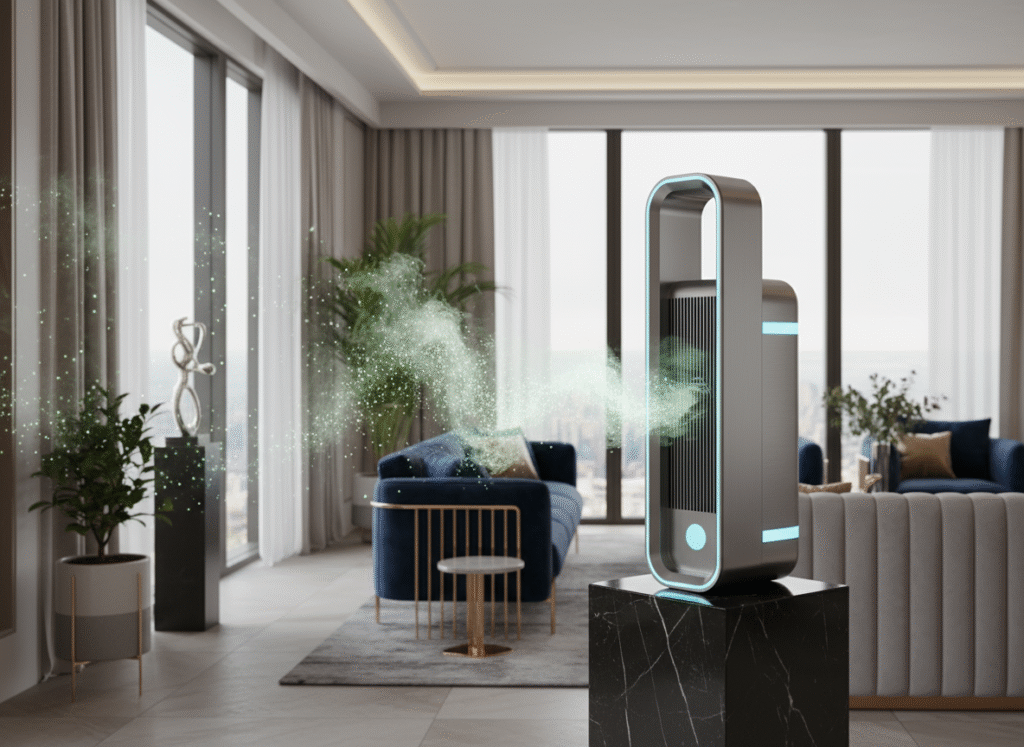
We see our homes as sanctuaries. However, indoor air quality is a silent crisis we often overlook. While fleeing pollution outside, we are left alone with allergens, dust, pet hair, cooking odors, and even chemicals released from our new furniture inside our homes.
It is at this point that air purifiers have become indispensable heroes of our living rooms and bedrooms.
But the market has become so crowded that making the right choice has become almost impossible. Which model is “the best”? Which technology truly works? What is “HEPA”? What does “CADR” mean?
If these questions are on your mind too, you are in the right place.
Section 1: The 4 Main Trends Shaping the Market
In the past, air purifiers were nothing more than a simple fan and filter. Now, these devices are rapidly evolving toward integrated smart systems and specialized technologies that neutralize specific pollutants.
1. Smart Integration is No Longer a Luxury
Wi-Fi connectivity and app control, once seen only in the most expensive models, are no longer a luxury. These features have now become an expected standard even in mid-range models. This means you can control your device remotely, monitor air quality in real-time, and even manage it with voice commands (Alexa, Google Assistant).
2. Advanced Sensor Technology
Most devices still use standard PM2.5 (fine particulate matter) laser sensors, which is a great start. But the premium segment has raised the bar. We now see specific sensors not just for dust, but also for Formaldehyde (new furniture smell), Nitrogen Dioxide (NO2 – traffic pollution), and other VOCs. This allows your device to decide much more intelligently when it needs to run and provides you with detailed, actionable data.
3. Energy Efficiency and Silence
An air purifier is designed to run 24/7. As such, we as consumers have become much more conscious of energy consumption and, especially, sleep mode noise levels that won’t disturb us at night. New technologies aim for exactly this: delivering high performance with less noise and lower energy consumption.
4. Filtration Wars: Is “True HEPA” Enough?
The market has moved beyond the standard “True HEPA” (which captures 99.97% of 0.3-micron particles) standard. There are now much more specific and powerful claims. For example, AirDoctor’s “UltraHEPA” technology, which claims to target particles down to 0.003 microns, or the massive 15 lbs of activated carbon mass in Austin Air’s filter. These systems focus on specific threats beyond standard allergens, such as mycotoxins or heavy chemicals.
Section 2: “Smart and Fast” or “Deep and Slow”?
1. “Smart and Fast” (Particle-Focused) Devices
- What They Focus On: These devices are designed to clean the air quickly. They offer high CADR (Clean Air Delivery Rate) values, efficient “Auto” modes based on sensitive PM2.5 sensors, and low energy consumption.
- Who Are They Ideal For? They are perfect for those troubled by common allergens (dust, pollen, pet dander). They filter the air rapidly and alleviate your allergy symptoms.
2. “Deep and Slow” (Gas/Chemical-Focused) Devices
- What They Focus On: These devices focus on the depth of filtration, not particle speed. They generally have a lower CADR-to-price ratio and are completely devoid of smart features.
- Who Are They Ideal For? These devices are not designed to clean the air quickly; they are designed to deeply purify and safely trap heavy chemicals, smoke, paint fumes, and VOCs within the filter.
Conclusion: What is your primary problem? Particle allergies, or chemical sensitivity? Your answer will guide you to one of these two categories.
Section 3: The Metrics That Make an Air Purifier “Perfect”
1. CADR (Clean Air Delivery Rate)
This is the most important, independently certified (by AHAM) standard for measuring a device’s performance. Simply put, it shows how much clean air a device produces in one minute. It is usually measured for three pollutants: Smoke, Dust, and Pollen. A high CADR value means faster cleaning and a larger room capacity.
2. ACH (Air Changes Per Hour)
This is an even more critical metric than CADR. It indicates how many times the device completely filters the entire air volume of your room in one hour. Brands often market enormous figures like “260 m² coverage.” However, the problem is: These massive numbers are usually based on 1 or 2 air changes per hour (1-2 ACH). This low exchange rate is not bad for general air quality, but it is insufficient for alleviating allergy or asthma symptoms.
3. Filtration Technology – HEPA
- True HEPA (H13): This is the industry standard. Used by most major brands like Levoit, Coway, and Alen, this technology is designed to capture 99.97% of airborne particles as small as 0.3 microns.
- HEPASilent (Blueair): Blueair’s proprietary technology. It combines mechanical filtration with electrostatic charging. This allows for the use of a less dense filter and captures particles down to 0.1 microns. The result: Lower noise levels (down to 23 dB) and less energy consumption for the same clean air output.
- UltraHEPA (AirDoctor): This technology claims to capture particles as small as 0.003 microns, which is claimed to be 100 times smaller than standard HEPA. This specifically targets ultra-fine pollutants like mold spores, viruses, and mycotoxins.
4. Gas and Odor Filtration (Carbon Filter)
Almost every air purifier claims to include a carbon filter. But this is a spectrum. Its effectiveness depends on the mass and surface area of the carbon.
- Low-Level (Deodorizing): A thin mesh or fabric coated with carbon. This can remove light household odors but is almost ineffective for VOCs or heavy smoke.
- Mid-Level (Granular Activated Carbon): Granules offer much more surface area to capture gases and VOCs and are much more effective.
- High-Level (Heavy-Duty Mass): True gas and chemical neutralization starts here. For example, the Austin Air HealthMate (HM400) filter contains 15 lbs (approx. 6.8 kg) of activated carbon and zeolite mix. This mass is designed not just to capture gases like formaldehyde and benzene, but to hold them safely for up to 5 years without re-releasing them into the air.
5. Noise and Energy
An air purifier should run 24/7. Therefore, noise and energy consumption can be more important than the initial purchase price. Its quietness determines whether that device can be used in your bedroom.
Section 4: Air Purifier Recommendations
1. Levoit Core 400S
- Category: Good Overall, Good for Allergies
- Filtration Technology: 3-Stage Filtration, H13 True HEPA Filter
- CADR: 260 CFM (Smoke)
- Coverage Area: 1718 ft² (1 ACH) – 30 m² (5 ACH)
- Noise: 22dB (Sleep Mode) – 52dB (Maximum)
- Sensor: AirSight™ Plus Laser Dust Sensor (PM2.5). This is a sensitive sensor that reacts quickly to even small changes in PM2.5 levels.
- Auto Mode: Automatically adjusts fan speed based on sensor data.
- Smart Integration: Full control via the free VeSync app, voice command support with Amazon Alexa and Google Assistant.
2. Coway Airmega AP-1512HH
- Category: A long-time favorite, Good for Pets
- Filtration Technology: 4-Stage Filtration, Pre-filter + Deodorization Filter + True HEPA Filter + Bipolar Ionizer
- CADR: Smoke 234 CFM, Dust 248 CFM, Pollen 232 CFM
- Coverage Area: 361 ft² (4.8 ACH) – 33 m² (4.8 ACH)
- Noise: 24dB (Minimum) – 53dB (Maximum).
- Auto Mode: Adjusts fan speed (1-3) based on air quality.
- Eco Mode: Energy-saving feature. Stops the fan when clean air is detected for 30 minutes.
3. Blueair Blue Pure 311i Max
- Category: Quiet Performance / Good Design
- Filtration Technology: HEPASilent Technology.
- CADR: Smoke 283 CFM, Dust 314 CFM, Pollen 365 CFM.
- Coverage Area: Approx. 41 m² (4.8 ACH)
- Noise: 23dB (Sleep) – 50dB (Max). HEPASilent technology keeps noise levels lower than competitors despite the high CADR value.
- Smart Integration: Wi-Fi control and air quality monitoring via the Blueair App.
4. Dyson Purifier Big+Quiet Formaldehyde
- Category: Premium / Advanced Technology
- Filtration Technology: HEPA H13-grade filter, Activated Carbon filter (specially developed to capture gases like NO2), and an SCO filter.
- CADR: Dyson does not publish AHAM CADR values. Instead, it focuses on its ability to purify the room evenly (up to 10 meters).
- Smart Integration: MyDyson app, Alexa, Google Assistant, and Siri Shortcuts.
5. Austin Air HealthMate (HM400)
- Category: Heavy-Duty VOC and Odor Removal
- Filtration Technology: 4-Stage: 2x Pre-filters, 15 lbs (6.8 kg) Activated Carbon and Zeolite, 5.5 m² True Medical-Grade HEPA.
- CADR: Not designed for particle cleaning speed.
- Coverage Area: Approx. 22 m² (5 ACH)
- Smart Integration: None.
Comparison Table
| Model | Category | CADR (Smoke) | Coverage Area | Filter Life |
|---|---|---|---|---|
| Levoit Core 400S | General | 260 | 30 m² (5 ACH) | 6 – 12 Months |
| Coway Airmega AP-1512HH | Pets | 234 | 33 m² (4.8 ACH) | 6 – 12 Months |
| Blueair Blue Pure 311i Max | Quiet / Design | 283 | 41 m² (4.8 ACH) | 6 – 12 Months |
| Dyson Purifier Big+Quiet Formaldehyde | Premium | Undisclosed | Est. 100 m² | 1 – 3 Years |
| Austin Air HealthMate (HM400) | VOC / Chemical | Approx. 154 (Dust) | Approx. 22 m² (5 ACH) | 5 Years |
Conclusion
Choosing an air purifier requires making a strategic decision between “Smart and Fast” devices (for particles) and “Deep and Slow” devices (for chemicals).
For the vast majority of consumers, a “Smart and Fast” device offers the best balance of performance, energy efficiency, and cost.
However, for those with specific problems like paint fumes in a new home, gases from city traffic, or severe chemical sensitivities, a “Deep and Slow” device like the Austin Air HealthMate – despite its complete lack of smart features-is the only real solution.
You are now ready to make an informed choice for breathing cleaner, healthier air.